
Update electricity mixes
Change generation shares and bilateral sourcing with explicit mappings or provider data.
Use a model with separate generation technologies, such as a supported EXIOBASE layout or EMERGING-E. Supply and trade shares answer different questions.
How is electricity produced?
update_supply_mix() changes generation shares. The "electricity"
preset uses EMBER fuel groups.
Where does it come from?
update_trade_mix() changes sourcing by destination. Its electricity
preset uses ENTSO-E scheduled commercial exchanges.
Update a generation mix#
With a supported model already parsed as db:
db.update_supply_mix(
    "electricity", scenario="updated_mix", clone_from="baseline",
)
Result · A scenario using the packaged provider snapshot. On an IOT,
the selected generation bundle is redistributed across z and Y.
On a supported SUT, generation commodities are combined and activity
market shares are updated in s.
The provider groups are coarser than native technologies. MARIO redistributes within each group using its existing internal composition. This does not independently estimate every technology’s historical share.
Inspect the resulting IOT mix
mix = db.get_mix("electricity", scenario="updated_mix")
See Inspect production mixes for units and the distinction between reference-product output and physical generation, including CHP by-products.
Use live provider data for a selected year
Register the provider key in your environment, then configure the session:
import os
import mario

mario.set_api_keys(ember=os.environ["EMBER_API_KEY"])
db.update_supply_mix(
    "electricity", scenario="updated_mix", year=2023, api_key="ember",
)
Without an explicit live-provider selection, the packaged snapshot is used. Uncovered regions or regions with no positive generation remain unchanged. A missing year can fall back to the nearest available observation; check the log before treating the result as a uniform-year update.
Separate generation and trade in an Isard SUT
Promote updated_mix to the baseline of a separate database, then pool
the shared electricity commodity. pool_trade() operates on the baseline
and discards other scenarios; promoting first keeps the generation update.
pooled_db = db.build_new_instance("updated_mix")
pooled_db.pool_trade("electricity")
pooled = pooled_db.meta.pooled_trade_map["electricity"]
pooled_db.update_trade_mix(
    "electricity", items=pooled["supply"], commodities=pooled["need"],
    level="Activity", scenario="trade_mix", clone_from="baseline",
    fill_uncovered_domestic=False,
)
The pool adds a pass-through activity and a need commodity per region.
pooled_db retains the updated generation mix; its trade_mix scenario
adds the sourcing update. Generation and sourcing occupy separate
market-share columns. The original db remains available for comparison.
This example uses the packaged ENTSO-E snapshot and keeps uncovered regions’
sourcing. Its net commercial exchanges are not physical cross-border flows.
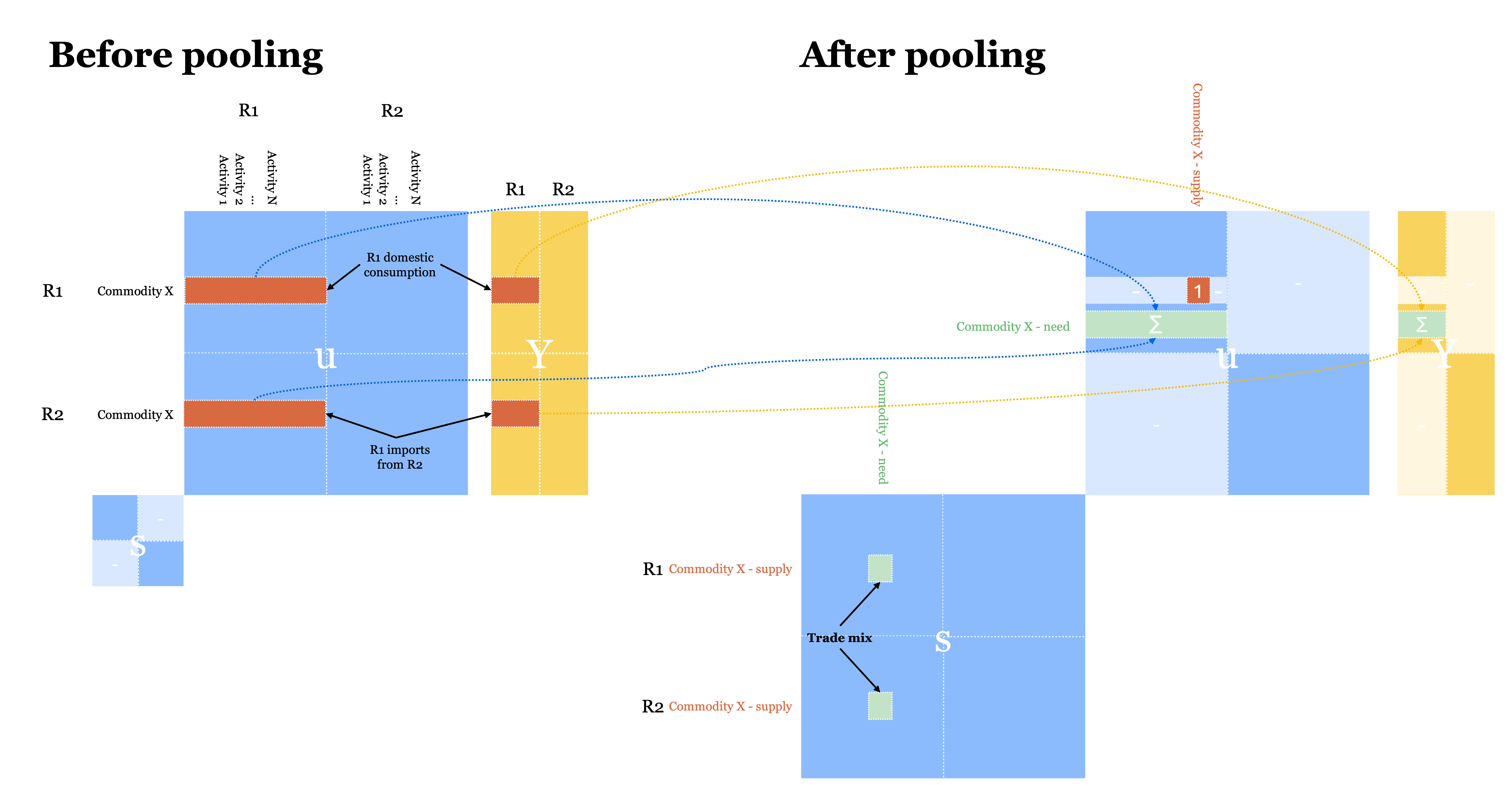
The supply activity connects production to each destination’s need market.#
Explicit mappings and destination filters
Supply accepts {region: {label: share}}; trade accepts
{destination: {origin: share}}. Use rescale=True when the supplied
totals need normalization. See the APIs for item and column selectors.
On a Chenery–Moses SUT, a producer’s technology appears in multiple
destination markets. Keep column_regions=None to update all of them;
a domestic-only filter would leave exported production on the old mix.
Full interfaces: update_supply_mix, pool_trade and update_trade_mix.